
Notes on LLM usage
Table of Contents
Human statement: I do not use LLMs in any of my blog posts for writing nor editing (though obviously it is the subject matter).
Introduction #
This post is about how I currently think about the use of LLMs to aid software development. I hope at least some of the ideas here are new, and if not I shed them in a newer light; failing that, that they are at least organised in a better way. It is not about my setup or my “workflow” as (a) that is heavily user-dependent, (b) it is probably going to go stale in a month, and (c) I don’t like the word “workflow.” This is about some common (anti-)patterns that I’ve encountered when trying to make matrix multipliers do my job faster for me.
My stance on this topic is not too controversial, I hope: I think that LLM tools like Claude and Codex represent a significant shift in how we work and how fast we can get work done. They’re good enough to do rote wiring tasks (and be trusted to get it right), bounce ideas off of, and make throaway visualisations. On the other hand, I do not think them good enough to make fine-grained software decisions or design systems intended to be maintained for any meaningful timeframe. Though automation is the name of the game, I think it is just as wrong to delegate everything to LLMs (though it is certainly a goal to strive towards) as these agents are hardly a replacement for proper human thought as it is to adopt a Luddite stance and refuse to use LLMs in writing code in a professional setting.
Using transport as an analogy, They’re like steam locomotives moreso than bicycles: if you set the tracks right, if you clear all obstacles, and if you know exactly where you want to go, then you’ll get to your destination faster than if you rode a bike. Indeed, there are a plethora of usecases for trains over bicycles in the modern world, but bicycles afford more control to the operator, are more nimble, can get you to more places, but require more skill to manouevre.
Restated, This blog post aims to explore good patterns in setting these train tracks, without going into if they should be set.
Finally, a quick disclaimer that most of everything I’m writing about here is just standard “good” engineering advice, but I believe these are the easiest to get started with practically, and yield outsized returns with comparatively low effort with the aid of a LLM.
Wireframes and clay & “AI native engineering” #
As part of my research in linguistic phylogenetics, I had a repo full of ad hoc scripts to run tree & population simulations, inference code to try out different inference methods on these simulated data, SLURM wrappers to submit these scripts, scoring scripts to score output, metrics, all sort of things. It was not obvious how things worked: it had some unit testing in Python but coverage was atrocious, Python type annotations were spotty, repo structure and input/output placement/formats were more conventions than anything else. Furthermore, there were hidden dependencies in my scripts (as in, if you ran certain scripts in the wrong order you’d just get silently wrong output).
This was obviously not production-grade code - it was the way it was because it was handwritten, I had other things taking up my time (busy college student things), and I was the only maintainer. All in all, quite bad! After graduating in 2025, I started working full-time and had even less time to devote to research. I already had a re-design of the repo in-the-works, and was slowly sketching things out and manually implementing the design, when in July 2026 (almost a year later!) I decided that this was just too slow and decided to get Claude to implement the design I had for me.
The premise was simple but ultimately took me more than a month to get done, even with the biggest model available at the time (Fable 5). I did not simply want to point the repo at Claude and
/ultracode hey Claude, make this repo better. Make no mistakes.
Instead, I took the time to sketch out the plugin based architecture, the data model, CLI tooling, etc., with the explicit end goal of this being that a reasonably competent LLM would be able to make extensions and run experiments when given in natural language, and that I would be able to have confidence that it did the right thing. LLMs are really good at pattern matching and prediction the most likely next token, and so the onus is on the developer to set good patterns. They’re also very good at “fuzzy” things like transcribing natural language requests to kind-of-OK code, so the developer must construct deterministic railing around which LLMs can operate safely and correctly. I think of this as building a wireframe around which we can lower the barrier to effective contribution and just let LLMs build out the surrounding clay sculpture.
This brings me to my first point, determinism and CLI tooling.
Determinism and CLI tooling #
The “bring Claude into my repo” story often goes like this:
- You clone your repository. You ask Claude to do something. It has no context. It falls on its face and you’re unhappy with it.
- You realise that you need good documentation to serve as context. You (or Claude) write docs. Claude is a little better but now its context is often bloated; common things are pretty unpredictable.
- You then identify common things that you’d like Claude to do repetitively. For example, running CI, reviewing PRs, or gathering context. You package these as custom skills to invoke. This makes sure your prompts are deterministic, but you soon find that your context again bloats, and the commands you ask Claude to run… don’t always get ran correctly.
- You then think to gather all the deterministic parts into a bash script and ask Claude to call these scripts in your skills. This effectively makes your skills deterministic and significantly reduces context bloat.
Sounds familiar? This is nothing new, not even with agents. This is exactly how devs work! Devs will onboard onto a new project, get acquainted, get frustrated with rote work, and build tools to help them automate (why do I have to manually run these 5 scripts in this exact order?). All the more valid when you intend for LLMs (far less predictable) to be dev-like.
So why not make step 3 the standard? I propose that the CLI (or any sort of deterministic tooling) itself should be a first-class citizen instead of a ragtag bunch of bash/python scripts referenced to by a skill. If you are primarily using agents to interact with the code, it is worth (a) defining the contact surface by defining all possible operations in the CLI and then asking your LLM to only run commands in the CLI, (b) making sure your CLI is easy to work with, and (c) building in observability into your CLI, that is, being able to observe its state. Oversimplifying of course but this is hopefully a simple modus ponens: if the only sanctioned way for agents to interact with things in your repo is through the CLI, and your CLI is implemented well, then your agents will be predictable and correct. If not, observability ensures that you (or another LLM) is able to course-correct and make itself better over time. Moreover, it won’t have to spend valuable time and tokens figuring out what’s correct to run, or run into any of the multitude of failure modes possible (e.g., your dataset’s not partitioned in the right way so queries subtly take much longer, assuming that a command appends instead of upserts so your data gets accidentally deleted, etc.) because it just has to run a single CLI command.
For example, my CLI in my phylogenetics research repo currently looks something like
(base) *[main]$ uv run -m  scripts.py.cli.main --help

 Usage: python -m scripts.py.cli.main [OPTIONS] COMMAND [ARGS]...

╭─ Options ────────────────────────────────────────────────────────────────────────────────────────────────────────────────────╮
│ --install-completion          Install completion for the current shell.                                                      │
│ --show-completion             Show completion for the current shell, to copy it or customize the installation.               │
│ --help                        Show this message and exit.                                                                    │
╰──────────────────────────────────────────────────────────────────────────────────────────────────────────────────────────────╯
╭─ Commands ───────────────────────────────────────────────────────────────────────────────────────────────────────────────────╮
│ simulation                                                                                                                   │
│ infer       Atomic inference on one dataset; renders the InferenceResult.                                                    │
│ score       RF-score one estimate against a reference Newick.                                                                │
│ summarize   Consensus-summarize a tree set to a single Newick.                                                               │
│ experiment                                                                                                                   │
╰──────────────────────────────────────────────────────────────────────────────────────────────────────────────────────────────╯
What makes this so valuable to do today is that LLMs are very good at this sort of rote CLI wiring! It’s up to the human to define which operations you’d like to expose, the parameterisations to allow, etc., but after that the CLI builds itself. This is an example of using an LLM to build scaffolding to make itself more reliable. Such cheap and tools are now viable because Code is Cheap; as nobody cares about this wiring it’s (relatively) fine it’s AI-generated slop. A few notes:
- This is runnable with
uv runso Claude does not have to worry about requirements, virtual environments, etc. For Python CLIs I recommend using uv; you could also make your CLIs blazing fast and use a compiled language such as C++ or Rust. - The commands section basically list all the operations that I’d like to be able to do:
simulation,infer,score, etc. Underneath they fan out to the aforementioned handwritten bash scripts - but Claude doesn’t need to know that, nor where they are situated, nor what order to run them in. That is all baked into the script. - paired with a short skill explaining what these commands are, how to use them, etc. you get something that is very powerful - Claude is smart enough to reason about what you want from natural language, and then just run the necessary commands.
Observability and the data model #
Another thing I improved with this setup is to have a very explicit data model for everything. The data model is how the human intends for the system to be reasoned about. It is a statement of what the problem space is and what we care about. What’s more, having an explicit data model lets Claude very easily have all the context it needs without having to go search everything up in different locations up. Again this contributes to everything being fast, context-efficient, and deterministic. Nothing groundbreaking here, just that the calculus has changed such that having a good data model is both easy to do and gives immense benefits.
In my particular case, I applied this in two ways: a YAML-based input model to specify an entire experiment, and making sure my outputs were stored in a predictable place + ensuring everything was trivially joinable. This YAML-based input model might look something like:
default_sim_configs: &default_sim_configs
  poly: high
  homoplasy_factor: 0.1
  n_chars: 80

experiment_folder: experiments/smoke_test
simulation:
  n_taxa: 30
  n_trees: 1
  simulation_params:
    # condition 1: high polymorphism
    - <<: *default_sim_configs
      poly: high
    # condition 2: low polymorphism
    - <<: *default_sim_configs
      poly: low

methods:
  mp4: {}
  astral_3:
    is_exact: False
    bipartition_strategies:
      - mp4_trees
      - ga_trees
  wastral: {}
The point of this file being that it is meant to be the singular source of truth to configure the CLI. This makes it very easy for Claude (or a human) to tell what is going on in a particular experiment instead of scouring a bunch logs / relying on file structure.
With the output, it’s just standard good data modelling: have a set of hopefully universal primary dimensions to join on, have informative facts, link to raw files, etc. I’m not here to tell you how to do data engineering properly (I’d probably be the last one you’d ask), I’m saying that even for personal projects, if you’re enlisting the help of LLMs it’s definitely worth it to try and establish a good data model. The only reason one wouldn’t do it for a personal project before was because it would be too much grunt work – but hey guess what LLMs are good at? With a short document to explain the semantics of columns and join keys, Claude becomes very good at understanding the problem space.
And if anything fails, all logs are stored and easily searchable (i.e., fixed format with fixed location conventions/semantics) and so diagnosis is easy.
Another example: seba
#
Another example I’d like to give is seba, a tutor skill I’m working on, and that I’m currently interacting with to go through the material in the fantastic Category Theory Illustrated. It follows a very similar pattern of a deterministic CLI + a skill to prime agents to interact with the CLI. It tries to solve the problem of “long-term learning,” i.e., if you want to learn a whole syllabus through Claude, you’re most likely going to need more than one session (or equivalently clear the same session). How do you persist learning progress through sessions? How does Claude know what to go over in each session? My solution is thus:
- When you first start a new subject, you give it some subject matter. Claude generates a syllabus of “goals” in YAML format (data model!) that might look something like
goal: Understand introductory probability
subject: probability
concepts:
  - id: sample-spaces
    name: Sample spaces and events
    prereqs: []
    soft_prereqs: []
    confusable_with: []
    kc_type: concept
    sources: []
    status: unseen
    est_sessions: 1
  - id: conditional-probability
    name: Conditional probability and Bayes
    prereqs: [sample-spaces]
    soft_prereqs: []
    confusable_with: []
    kc_type: concept
    sources: []
    status: unseen
    est_sessions: 2
- Every session is focused on a new goal, and Claude is instructed to run
seba statusto see statuses of all goals, then to pick one and runseba start GOAL. During a session Claude may mark a goal with its difficulty (paired with a spaced repetition module to maximise recall) / add notes such as what went well, common confusion points, etc. to a Markdown file. All of these operations have a dedicated CLI command, so that Claude only has to know to use these commands and to teach; everything else is already structured. Indeed, we should use LLMs for what they were meant to be used for: as a natural language text interface; everything else can and should be delegated to scripts.
Throwaway code as dev tools #
The argument I gave above on why CLIs are conducive to LLM development and usage (the ability to have autogenerated tools to support main core software) can be extended to other parts of the developer experience. There is a wide gap between “my only job is to hit the merge button” and “I’m handwriting everything.” LLMs offer optionality: the option to not care about the code if you trust its function. It does not mean you care about no code (this is called being irresponsible). To be effective, an engineer needs to very consciously make the tradeoff between code that she cares about, and code she does not.
I do not think it controversial to say that the understanding of code (or at the very least the architecture), the intent behind development, the decision making process, and proper human thought behind codebases should not be outsourced to machines. However, much of that can be made more efficient if you allow LLMs to help. For example, generating dashboards for designs to share with teammates, or for greater observability around your systems are all very good reasons for “throwaway code,” you don’t need to care about the HTML frontend nor how it’s hosting the HTTPS website, just that you have a usable interface (and perhaps that it’s pulling from the right APIs) to share around with teammates. Once again one sees productivity increases for next to no effort - Claude is more than good enough at writing HTML to make a pretty(ish) frontend that displays data.
Reviewing code is another front of this - suppose that you’re working on something that you do want to fully control and understand (gasp, understand!). I think it’s acceptable for such changes to be almost entirely AI-generated as long as you are able to explain all of it and have read the entire thing. What often happens is that after agreeing on a plan/spec with Claude, you ask it to execute the plan and you review the diff on GitHub because it allows you to leave comments. Problem is, it is not fun to read a PR diff the way GitHub presents it - in sorted filename order. Instead, it is much better if it is presented in some other way (call stack/DAG order, interactive walkthroughs, etc). In this case, far from inducing AI paralysis, it accelerates and deepens human understanding by presenting code in a more human-friendly way so that it can be reviewed and picked apart.
Human PR review is still very much necessary. Skills like /code-review, /ponytail, &co can only take you so far, because LLMs are ultimately local optimisers, making code look good locally. That is good and important, but most people want more than a glorified lint check to pass before declaring some PR shippable. LLMs do not know why you designed the architecture this way (of course you can write it in the spec but does anybody actually write down every minute decision that affects the design?), because you didn’t tell it.
In short, it does not understand intent.
Code as intent #
When you write a piece of software, you have all sorts of things in mind. How your code should behave and that it should pass unit tests / integration tests / linters is only the first layer. I subscribe to Naur’s view that programming is theory building, and encoded within the codebase are innumerable tiny decisions around how to organise code, subtle tradeoffs in performance, readability, extensibility, etc., that are just not discernable by unit tests alone. Tests and asserts you don’t write matter as much those that you do (because they might represent some underlying assumption that you know is valid, for example), repeated dataclasses might not be bloat but a conscious statement on module boundaries, and architecture designs often make it easier or more difficult for a piece of software to be extended in various ways, implicitly encoding the engineer’s vision. None of this can be captured by benchmarks or a skill because (a) this is often a matter of taste and hence subjective, and more fundamentally, (b) you cannot test for what is expected to be absent. A simple function with 1000 unit tests and way too many guards in its code will work but will not sufficiently express the intent of the function (not to mention its performance). Passing unit tests means low FN (nothing was missed) but says nothing about FP (why did you write this? what is the failcase here? why did you write an essay in a comment block around a simple one liner?).
One might make the counterargument that this is only valid insofar as humans need to read the code, and as models get more powerful, one will not need to read the code just like we do not (often) read compiled machine code. The analogy here is that the C++/machine code of yesteryear is directly comparable to the Markdown/actual C++ of the present. Sure - you can try to describe everything comprehensively in a spec in natural language, but one often finds that this spec is not so far removed from the code itself. Not to mention that natural language is extremely lossy and ambiguous in the way that proper programming languages are not.
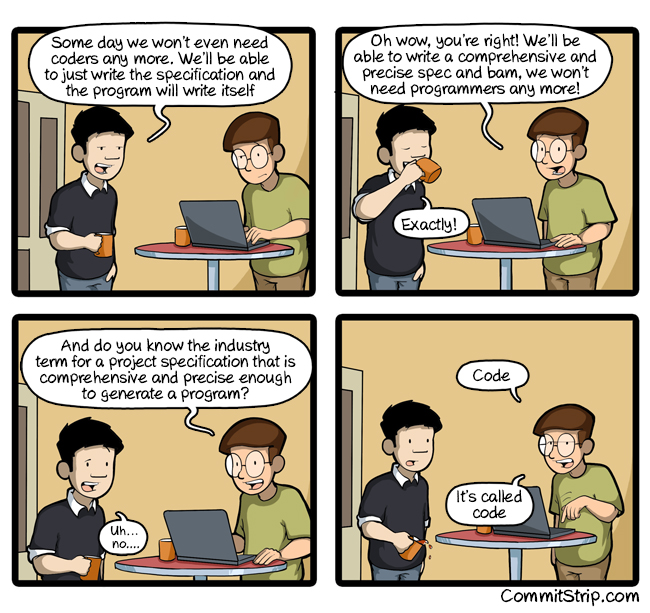
That is not to say you should not do spec-driven development, just that you have to take care in doing so. I find it most useful to jot down an existing design / write pseudocode – and then iterate with Claude to iron things out and then turn it into a spec to implement, trusting in its ability to do the annoying wiring up. Seeding Claude with a design you already know drastically improves your ability to read and critique its code later on, though it often will still make (subtle!) mistakes. Being able to identify these subtle mistakes and critique an architecture is why I still think a proper (not necessarily formal) CS education is still (and even more) valuable in this age of vibecoding with stochastic parrots.
These sorts of mistakes are often not due to “the model being dumb” (though it does happen), but that it’s trying to make a tradeoff based on limited/guessed/wrong information. Not saying that you can’t anticipate every assumption it’ll make and bake it into the spec, just saying that at some point you run into diminishing returns, and if you successfully do that you’ve written, for all intents and purposes, code anyway.
Tending the garden #
I did not come up with this analogy myself, but thought it’d be useful to share.
Tending a garden: traditional (i.e., handwritten) software is very deliberate and slow, it’ll get the job done and you’ll come out on the other side after a lot of toil, and skilled landscapers will end up with a beautiful garden. Now imagine you want to expand to managing a much larger garden, and you come into posession of a large quantity of extremely potent bonemeal. These stochastic code parrots are exactly like that bonemeal: it is very powerful but hard to control and can easily make your life a lot worse if not done correctly. The misuse of this bonemeal will turn your garden into an anarchic wastefield, but if you know to construct frames and supports around which you guide your plants to grow, then you have a very effective way to manage a bigger estate, able to complete larger projects in a fraction of the time as before. With traditional gardening, you did not have to construct any frames or scaffolds but to be able to use bonemeal you have to invest in extra steps to keep your plants behaving; in other words, you changed the way you work to make the best use of a much more powerful tool.
TL;DR #
AI-assisted engineering is here to stay, and that it offers us optionality to decide which parts of code we care about vs it just being scaffolding / throwaway dashboards. Having a clean set of (CLI) tools and a transparent data model so that LLMs and humans can more easily interact with the code base pays dividends; with how good AIs are at wiring things up these are almost free wins that even codebases with a single contributor can benefit from. Lastly, I do not think that models are good enough to manage larger systems that people care about just yet for structural reasons - own your design and your thought process!